Had to Stop by the War Museum to Give for the Finger Again
Copyright notice
This article is from Tar Heel Junior Historian, published for the Tar Heel Inferior Historian Clan past the North Carolina Museum of History. Used by permission of the publisher. For personal use and not for farther distribution. Please submit permission requests for other uses directly to the museum editorial staff.
Is anything in this article factually incorrect? Delight submit a comment.
Amputations in the Ceremonious State of war
Originally published equally "When Johnny Couldn't Come Marching Home: Ceremonious State of war Amputations"
by Ansley Herring Wegner
Reprinted with permission from the Tar Heel Junior Historian. Fall 2008.
Tar Heel Junior Historian Association, NC Museum of History
 Mind to this entry
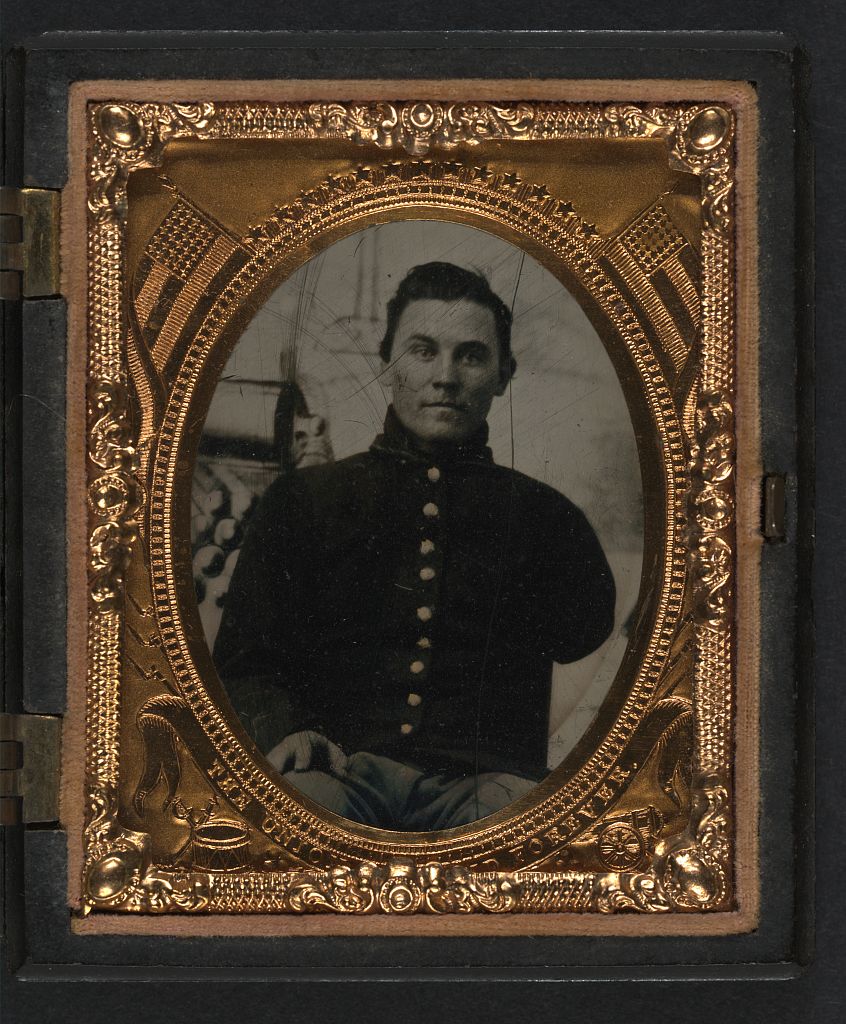 Many wounded soldiers during the Civil War (1861–1865), including those from Due north Carolina, had an operation called an amputation. In an amputation, a person has an arm or leg (or sometimes just a mitt or foot) removed from their body considering of a terrible injury or infection. Armed forces advances before and during the Civil War meant more powerful, destructive weapons, and more than devastating injuries, including shattered bones. About American doctors, however, were unprepared to treat such terrible wounds. Their feel mostly included pulling teeth and lancing boils. They did non recognize the need for cleanliness and sanitation. Little was known about bacteria and germs. For instance, bandages were used over and over, and on different people, without being cleaned.
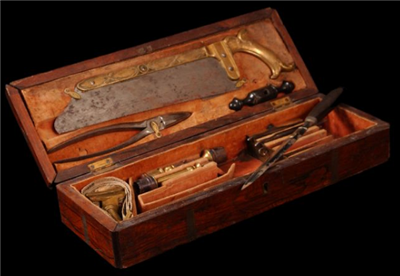
With so many patients, doctors did not take time to exercise tiresome surgical repairs, and many wounds that could be treated easily today became very infected. And then the army medics amputated lots of arms and legs, or limbs. Well-nigh three-fourths of the operations performed during the state of war were amputations.
These amputations were done by cut off the limb quickly—in a circular-cut sawing motion—to keep the patient from dying of daze and pain. Remarkably, the resulting blood loss rarely caused death. Surgeons often left amputations to heal by granulation. This is a natural process by which new capillaries and thick tissue form—much similar a scab—to protect the wound. When they had more time, surgeons might apply the "fish-mouth" method. They would cut skin flaps (which looked similar a fish's mouth) and sew together them to form a rounded stump.
 For soldiers who survived amputation and infection, information technology was natural to want an artificial, or fake, limb—both for looks and for function. An artificial arm will not provide a house handshake, and an artificial leg will not get rid of a limp. But a prosthetic (some other word used for an artificial limb) helps an amputee be less noticeable in public and offers the take a chance of a more regular daily life. Bogus limbs, particularly legs, helped Ceremonious War amputees become back to work to back up themselves and their families. Agriculture had declined with so many soldiers away from domicile. Afterward the war ended, it was of import for men to return to their farms and increase production of food and money-making crops. Amputees were no different—they needed to be able to piece of work on their farms, besides.
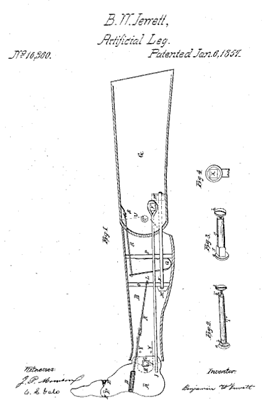 Northward Carolina responded quickly to the needs of its citizens. Information technology became the first of the former Confederate states to offer artificial limbs to amputees. The General Assembly passed a resolution in Feb 1866 to provide artificial legs, or an equivalent sum of money (seventy dollars) to amputees who could non apply them. Because artificial arms were non considered very functional, the country did not offer them, or equivalent money (fifty dollars), until 1867. While North Carolina operated its artificial limbs program, 1,550 Confederate veterans contacted the government for help.
One Tar Heel veteran, Robert Alexander Hanna, had enlisted in the Confederate ground forces on July 1, 1861. Two years later on at Gettysburg, Pennsylvania, Hanna suffered wounds in the head and the left leg, just above the ankle articulation. He suffered for nigh a month, with the wound oozing pus, before an amputation was done. After the state of war, Hanna received a wooden Jewett's Patent Leg from the state in January 1867. Co-ordinate to family members, he saved that leg for special occasions, having made other artificial limbs to assist him do his farmwork. (I homemade leg had a bull's hoof for a foot!) The special care helped the Jewett'southward Patent Leg last. When Hanna died in 1917 at nigh eighty-five years old, he had had the artificial leg for fifty years. It is a remarkable antiquity—the merely state-issued artificial leg on display today in Northward Carolina. Hanna's wooden leg, as well as Ceremonious War surgical equipment, may exist seen at Bentonville Battlefield Land Historic Site in Four Oaks.
*Ansley Herring Wegner is a research historian with the North Carolina Office of Athenaeum and History. She is the author of Phantom Pain: North Carolina's Bogus-Limbs Program for Confederate Veterans.
1 January 2008 | Wegner, Ansley Herring
Source: https://www.ncpedia.org/history/cw-1900/amputations
0 Response to "Had to Stop by the War Museum to Give for the Finger Again"
Post a Comment