Online Copy of Nineteenth Century Art a Critical History 3rd Edition
Upwardly until the mid-nineteenth century, this panel and its two companions (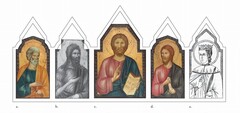 [fig. 1]
 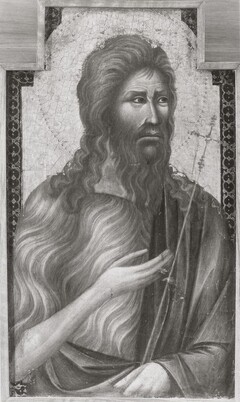 [fig. 2]
Véronique Damian and Jean-Claude Giroud, Peintures florentines, Collections du Musée de Chambéry (Chambéry, 1990), 66–67. The panel entered the museum in 1914 as a gift of Leonce Mesnard. I have been unable to establish the painting's fate in the fourth dimension period between the 1851 sale and 1914.
The fate of this painting is as well unknown. Information technology never resurfaced subsequently its sale at the abovementioned auction. However, the drawing of information technology published in the Artaud de Montor catalog (1843) suffices to evidence that the collector's identification of the crowned female person saint with Saint Clare of Assisi was mistaken. The martyr saint in question is clearly of royal nascence, if not a queen; George Kaftal plausibly recognized her as Saint Ursula. George Kaftal, Saints in Italian Fine art, vol. i, Iconography of the Saints in Tuscan Painting (Florence, 1952), 996.
While the adult Christ appears with some frequency at the heart of altarpieces, at least in the area of Lazio, in the twelfth and thirteenth centuries, this iconography is rarer in Tuscany, where the centre panel or compartment is usually filled with the Madonna and Child. Cf. Edward B. Garrison, Italian Romanesque Panel Painting: An Illustrated Index (Florence, 1949), nos. 278, 279, 280, 298, 305. Pregnant exceptions are Meliore'due south altarpiece in the Uffizi, Florence (no. 9153); that in the Museo Nazionale in Pisa (no. 1582) and dating to the early years of the Trecento; and Giotto's polyptych at present in the Due north Carolina Museum of Fine art at Raleigh, no. GL. sixty.17.7. Other sui generis cases are presented by the Stefaneschi altarpiece in the Pinacoteca Vaticana, executed for Saint Peter's basilica in Rome and hence reflecting local iconographic conventions, and the polyptych of Taddeo Gaddi formerly in the Bromley Davenport collection, in which the central image represents not the blessing Christ but the Vir dolorum. For the latter painting, see Andrew Ladis, Taddeo Gaddi: Disquisitional Reappraisal and Catalogue Raisonné (Columbia, MO, 1982), twenty–21. Yet after the early decades of the fourteenth century, altarpieces with Christ at the center disappear completely, only to reappear sporadically in the second half of the century; cf. Millard Meiss, Painting in Florence and Siena later on the Blackness Death (Princeton, 1951), 9–10.
P. Due north. Cianfogni and Domenico Moreni, Memorie istoriche dell'Ambrosiana R. Basilica di S. Lorenzo di Firenze, three vols. (Florence, 1804), ane:136–139.
In Florence, panels with similarly decorated gold grounds are establish especially in representations of the Maestà. We may cite, for example, the three versions of the Maestà that take come up down to us from the hand of Cimabue, Duccio's Madonna Rucellai, or the altarpiece of the Magdalen Principal in the church of San Michele at Rovezzano virtually Florence. See Luciano Bellosi, Cimabue, ed. Giovanna Ragionieri (Milan, 1998a), 105–112, 132, 136, 248; and Angelo Tartuferi, La pittura a Firenze nel Duecento (Florence, 1990), pl. 163. It is worth pointing out, however, that the Lucchese master Deodato Orlandi too used this type of ornament on horizontal altarpieces with half-length figures of saints. Examples include the i dated 1300 at present in the Museo Nazionale in Pisa (no. 1586); the dismembered and dispersed polyptych of which the center console is known, formerly in the Hurd collection in New York, inscribed with the date 1308; and even in a portable tabernacle, like that now in the Gemäldegalerie in Berlin. See Mariagiulia Burresi and Antonino Caleca, eds., Cimabue a Pisa: La pittura pisana del Duecento da Giunta a Giotto (Pisa, 2005), 260–261; Edward B. Garrison, Italian Romanesque Panel Painting: An Illustrated Index (Florence, 1949), 160 no. 418; Miklós Boskovits, ed., Frühe italienische Malerei: Gemäldegalerie Berlin, Katalog der Gemälde, trans. Erich Schleier (Berlin, 1988), 256–259.
Edward B. Garrison, Italian Romanesque Panel Painting: An Illustrated Alphabetize (Florence, 1949), 173, observed that the peculiar profile of the erstwhile Artaud de Montor panels seems unique among paintings dating to this period. Simply this does non necessarily imply, as Garrison believed, that it is the effect of modern falsification. Nor does Garrison's uncertainty regarding the genuineness of the appearance of the paintings in the mode they were illustrated in the drawing published in the Artaud de Montor catalog seem justified. Information technology should be borne in listen that the outer frame of the altarpiece has been lost, probably when the figures were separated and their profiles adapted to the painted internal frame. The external frame originally might have had a dissimilar profile, for instance like that of the Sienese triptych no. 11 in the Museum of Fine Arts, Budapest, which still preserves its original mixtilinear external frame while the ornamental border that delimits the upper role of the scenes is trefoil shaped. Another similar case is the Florentine Madonna in the Acton collection in Florence, which originally formed the eye of an altarpiece; information technology too is executed on wood with horizontal graining (cf. Garrison 1949, no. 635). Here, the painted inner frame is arch shaped, whereas the outer frame placed over information technology is triangular in profile. It is therefore difficult to reconstruct with whatever precision the original external profile of the polyptych by Grifo di Tancredi. Altarpieces with half-length figures, executed on a unmarried horizontal-grained wooden support, stand for an primitive grade that Sienese painters abandoned around 1300 just that continued to exist used sporadically in Florence in the early decades of the fourteenth century. The best known example is the polyptych of Santa Reparata, produced in Giotto's shop no before than c. 1310; cf. Giorgio Bonsanti and Alfio Del Serra, in Capolavori e restauri (Florence, 1986), 354–357. Cf. also the examples cited in Provenance note three.
Artaud de Montor probably acquired the National Gallery of Fine art'due south panels in Italia in the later years of the eighteenth or early years of the nineteenth century. They came to him accompanied by the attribution (wholly unjustified) to "Margaritone d'Arezzo," with which they were later illustrated in the successive catalogs of his drove (1808, 1811, 1843).
Alexis-François Artaud de Montor, Considérations sur l'état de la peinture en Italie, dans les quatre siècles qui ont précédé celui de Raphaël: Par un membre de l'académie de Cortone; Ouvrage servant de catalogue raisonné à une drove de tableaux des XIIe, XIIIe, XIVe et XVe siècles (Paris, 1808), nos. xxx, 31, 34; Alexis-François Artaud de Montor, Considérations sur l'état de la peinture en Italie, dans les quatre siècles qui ont précédé celui de Raphaël, par united nations membre de l'Académie de Cortone (Artaud de Montor): Ouvrage retainer de catalogue raisonné à une collection de tableaux des XIIe, XIIIe, XIVe et XVe siècles (Paris, 1811), nos. 35, 36, 39; Alexis-François Artaud de Montor, Peintres primitifs: Collection de tableaux rapportée d'Italie (Paris, 1843), nos. 35, 36, 39.
Bernard Berenson, "A Newly Discovered Cimabue," Fine art in America viii (1920): 250–271.
Miklós Boskovits, A Disquisitional and Historical Corpus of Florentine Painting, sec. ane, vol. 1, The Origins of Florentine Painting, 1100 – 1270 (Florence 1993), 142–144, 726–733. The mosaics of the Florentine church, executed in the 1270s probably by the Chief of Sant'Agata, were restored for the commencement fourth dimension in 1297 and then later besides. They are now rather hard to read, but the effigy of Christ, which Berenson compared with the Christ in the Washington painting, belongs to the primeval phase of the programme. Come across Miklós Boskovits, A Disquisitional and Historical Corpus of Florentine Painting, Sec. i, vol. ii, The Mosaics of the Baptistery of Florena (Florence 2007), 207 northward. 158, 603–607.
Roberto Paolo Novello, "I mosaici," in Il Duomo di Pisa, ed. Adriano Peroni, 3 vols. (Modena, 1995), ane:286–287, 556–558.
Alessio Monciatti, in La basilica di San Francesco ad Assisi, ed. Giorgio Bonsanti (Modena, 2002), 503–504.
Fiftieth Anniversary Exhibition: Loans and Special Features (New York, 1920), unnumbered itemize; Loan Exhibition of Important Early Italian Paintings in the Possession of Notable American Collectors (New York, 1924), no. 2; and Raymond Escholier et al., Exposition de l'art italien de Cimabue à Tiepolo (Paris, 1935), 51.
This is the console from the church building of Santa Trinita (no. 8343), variously dated. More recent scholarship has tended to engagement it to the last decade of the thirteenth century; cf. Luciano Bellosi, Cimabue, ed. Giovanna Ragionieri (Milan, 1998), 249–256.
Lionello Venturi, Pitture italiane in America (Milan, 1931), no. 8; Lionello Venturi, Italian Paintings in America, trans. Countess Vanden Heuvel and Charles Marriott, 3 vols. (New York and Milan, 1933), 1: no. 10; Enzo Carli, "Cimabue," in Enciclopedia cattolica, 12 vols. (Florence, 1949), iii:1614; Pietro Toesca, Il medioevo, 2 vols., Storia dell'arte italiana 1 (Turin, 1927), 2:1040 due north. 48; Luigi Coletti, I Primitivi, vol. 1, 120 tavole (Novara, 1941), 37.
Raimond van Marle, The Development of the Italian Schools of Painting, vol. 1, From the 6th Until the Finish of the 13th Century (The Hague, 1923), 476, 574; Raimond van Marle, The Development of the Italian Schools of Painting, vol. five, The Local Schools of Central and Southern Italian republic of the 14th Century (The Hague, 1925), 442, fig. 262; Raimond van Marle, Le scuole della pittura italiana, vol. one, Dal Vi alla fine del XIII secolo (The Hague, 1932), 495–496, fig. 321; Richard Offner, "A Remarkable Exhibition of Italian Paintings," The Arts 5 (1924): 244.
Mario Salmi, "Per il completamento di un politico cimabuesco," Rivista d'arte 17 (1935): 114.
Roberto Longhi, "Giudizio sul Duecento," Proporzioni two (1948): 19, 47.
Come across Angelo Tartuferi, in Dipinti, vol. i, Dal Duecento a Giovanni da Milano, Cataloghi della Galleria dell'Accademia di Firenze, ed. Miklós Boskovits and Angelo Tartuferi (Florence, 2003), 94–98.
Bernard Berenson, Italian Pictures of the Renaissance: Florentine School, 2 vols. (London, 1963), 1:50.
The following authorities spoke of "school" or "following" of Cimabue: Giulia Sinibaldi and Giulia Brunetti, eds., Pittura italiana del Duecento e Trecento: Catalogo della mostra giottesca di Firenze del 1937 (Florence, 1943), 277; Roberto Salvini, Cimabue (Rome, 1946), 23; Roberto Salvini, "Cimabue," in Enciclopedia Universale dell'Arte, ed. Istituto per la collaborazione culturale, fifteen vols. (Florence, 1960), 3:473; Richard Offner, A Critical and Historical Corpus of Florentine Painting: The Fourteenth Century, sec. iii, vol. 5, Bernardo Daddi and His Circumvolve, ed. Miklós Boskovits, Ada Labriola, and Martina Ingendaay Rodio, new ed. (Florence, 2001), 472 due north. 1; Edward B. Garrison, Italian Romanesque Panel Painting: An Illustrated Alphabetize (Florence, 1949), 172–173; Millard Meiss, Painting in Florence and Siena subsequently the Black Death (Princeton, 1951), 9 northward. 2; Carlo Ludovico Ragghianti, Pittura del Dugento a Firenze (Florence, 1955), 127; Sergio Samek Ludovici, Cimabue (Milan, 1956), 42–44; Hellmut Hager, Dice Anfänge des italienischen Altarbildes: Untersuchungen zur Entstehungsgechichte des toskanischen Hochaltarretabels (Munich, 1962), 111–112; Mario Salmi, "La donazione Contini Bonacossi," Bollettino d'arte 52 (1967): 223; Burton B. Fredericksen and Federico Zeri, Demography of Pre-Nineteenth-Century Italian Paintings in North American Public Collections (Cambridge, MA, 1972), 54, 403, 440, 645; Enio Sindona, L'opera completa di Cimabue due east il momento figurativo pregiottesco (Milan, 1975), 119–120; Fern Rusk Shapley, Catalogue of the Italian Paintings, two vols. (Washington, DC, 1979), 1:134–135; Meryle Secrest, Duveen: A Life in Art (New York, 2004), 422. Longhi's 1963 attribution to the Main of San Gaggio, in Roberto Longhi, "In traccia di alcuni anonimi trecentisti," Paragone 14 (1963): x, was accustomed in turn past Ugo Galetti and Ettore Camesasca, Enciclopedia della pittura italiana, 3 vols. (Milan, 1951), 2:1486 (though the three paintings were also listed amidst the works of Cimabue on p. 672 of the same publication); Michel Laclotte, De Giotto à Bellini: Les primitifs italiens dans les musées de France (Paris, 1956), fifteen; Luisa Marcucci, Gallerie nazionali di Firenze, vol. ane, I dipinti toscani del secolo XIII (Rome, 1958), 56; Luisa Marcucci, in Le Musée des Beaux-Arts de Chambéry (Chambéry, 1960), n.p., fig. 15; Giovanni Previtali, La fortuna dei primitivi: Dal Vasari ai neoclassici (Turin, 1964), 232; Giovanni Previtali, Giotto e la sua bottega (Milan, 1967), 26; Carlo Volpe, "La formazione di Giotto nella cultura di Assisi," in Giotto e i giotteschi in Assisi (Rome, 1969), 38; Miklós Boskovits, "Cenni di Pepe (Pepo), detto Cimabue," in Dizionario biografico degli italiani, 82 vols. (Rome, 1979), 23:452; Fra Ludovico da Pietralunga and Pietro Scarpellini, Descrizione della Basilica di S. Francesco e di altri Santuari di Assisi (Treviso, 1982), 416; Alessandra Guerrini, "Maestro di San Gaggio," in La Pittura in Italy: Il Duecento e il Trecento, ed. Enrico Castelnuovo, ii vols. (Milan, 1986), two:625; Luiz Marques, La peinture du Duecento en Italie centrale (Paris, 1987), 202, 286; Angelo Tartuferi, La pittura a Firenze nel Duecento (Florence, 1990), 63, 109; Véronique Damian and Jean-Claude Giroud, Peintures florentines, Collections du Musée de Chambéry (Chambéry, 1990), 23, 66–67; "Artaud de Montor, Jean Alex Francis," in The Lexicon of Art, ed. Jane Turner, 34 vols. (New York, 1996), 2:514.
Miklós Boskovits, ed., Frühe italienische Malerei: Gemäldegalerie Berlin, Katalog der Gemälde, trans. Erich Schleier (Berlin, 1988), 122, proposed an integration of the bitty inscription of the triptych in the drove of the Earl of Crawford and Balcarres.
Miklós Boskovits, A Disquisitional and Historical Corpus of Florentine Painting, sec. one, vol. ane, The Origins of Florentine Painting, 1100–1270 (Florence 1993), 732 n. 1, 809; Luciano Bellosi, Cimabue, ed. Giovanna Ragionieri (Milan, 1998), 129; Luciano Bellosi, "La lezione di Giotto," in Storia delle arti in Toscana: Il Trecento, ed. Max Seidel (Florence, 2004), 96; Rolf Bagemihl, "Some Thoughts most Grifo di Tancredi of Florence and a Fiddling-Known Panel at Volterra," Arte cristiana 87 (1999): 413–414; Angelo Tartuferi, "Grifo di Tancredi," in Dizionario biografico degli italiani, 82 vols. (Rome, 2002), 59:398; Sonia Chiodo, in L'arte a Firenze nell'età di Dante (1250–1300), ed. Angelo Tartuferi and Mario Scalini (Florence, 2004), 110–114; Andrea Staderini, "Un contesto per la collezione di 'primitivi' di Alexis-François Artaud de Montor (1772–1849)," Proporzioni 5 (2004): 38; Pierluigi Leone De Castris, "Montano d'Arezzo a San Lorenzo," in Le chiese di San Lorenzo e San Domenico: Gli ordini mendicanti a Napoli, ed. Serena Romano and Nicolas Bock (Naples, 2005), 109.
Luiz Marques, La peinture du Duecento en Italie centrale (Paris, 1987), 202, 286; Edward B. Garrison, Italian Romanesque Panel Painting: An Illustrated Index (Florence, 1949), 172–173; Angelo Tartuferi, La pittura a Firenze nel Duecento (Florence, 1990), 63, 109; Angelo Tartuferi, "Grifo di Tancredi," in Dizionario biografico degli italiani, 87 vols. (Rome, 2002), 59:398; Rolf Bagemihl, "Some Thoughts about Grifo di Tancredi of Florence and a Trivial-Known Console at Volterra," Arte cristiana 87 (1999): 413–414; Sonia Chiodo, "Grifo di Tancredi," in Allgemeines Künstlerlexikon: Die bildenden Künstler aller Zeiten und Völker, ed. Günter Meißner, 87 vols. (Munich, 2009), 62:129. See also Luisa Marcucci, Gallerie nazionali di Firenze, vol. one, I dipinti toscani del secolo Thirteen (Rome, 1958), 56; Hellmut Hager, Die Anfänge des italienischen Altarbildes: Untersuchungen zur Entstehungsgechichte des toskanischen Hochaltarretabels (Munich, 1962), 111–112; Roberto Longhi, "In traccia di alcuni anonimi trecentisti," Paragone 14 (1963): 10.
An aid for solving the problem of dating may come from the console that gave its name to the painter, namely the Maestà now in the Accademia. This is not dated, but some clues suggest that information technology was executed in the early years of the fourteenth century.
The monastery of the Augustinian nuns defended to San Gaggio (= Caius), sometimes described as having been founded in the fourteenth century, in fact already existed in the 1270s, as demonstrated by a attestation of 1274; cf. Guido Carocci, I dintorni di Firenze, vol. ii, Sulla sinistra dell'Arno (Florence, 1907), 289; Robert Davidsohn, Forschungen zur älteren Geschichte von Florenz, 4 vols. (Berlin, 1896), 4:416. At that time, the community of cloistered nuns, called "donne rinkiuse di San Gaggio," probably was very small; perhaps they did not even have their own church. That such a church presumably existed around the turn of the century tin, still, be inferred from documents of 1299 and 1304, cited by Domenico Moreni, Notizie istoriche dei contorni di Firenze, vol. 6, Dalla Porta a Pinti fino a Settignano (Florence, 1795), 207, which speak of a monastero and its badessa. Grifo'southward painting, a Maestà, judging from its fame and size, cannot have been destined for the high chantry: instead, it adorned the coming together place of a religious confraternity in the church; cf. Hans Belting, Bild und Kult: Eine Geschichte des Bildes vor dem Zeitalter der Kunst (Munich, 1990), 433–446. It therefore presupposes the being of a church open to the public and for this reason additionally seems more probable to date afterwards than before c. 1300.
No. 6115 of the Galleria dell'Accademia was attributed to the Principal of Santa Cecilia by Mario Salmi, "Spigolature d'arte toscana," L'Arte 16 (1913): 209–210; Raimond van Marle, The Development of the Italian Schools of Painting, vol. 2, The Sienese School of the 14th Century (The Hague, 1924), 293–294; Ugo Procacci, La R. Galleria dell'Accademia di Firenze (Rome, 1936), 22. On the other hand, Roberto Longhi noted in a youthful polyptych past Pacino di Bonaguida, at present in the drove of the Cassa di Risparmio of Florence, "united nations aspetto torvo simile a quello datoci" (a surly expression similar to the one given to usa) past the "Maestro di San Gaggio" in the former Artaud de Montor altarpiece. Roberto Longhi, "In traccia di alcuni anonimi trecentisti," Paragone 14 (1963): 10.
Even in his first intervention, Roberto Longhi noted in the San Gaggio altarpiece and in the panels at present in Washington reflections of the "prime sterzature plastiche del Giotto giovane" (the first turns of the wheel towards the plasticity of the young Giotto). Roberto Longhi, "Giudizio sul Duecento," Proporzioni 2 (1948): nineteen. For his function, Luisa Marcucci expressed the view that "l'autore della tavola di San Gaggio, quando la dipinse . . . aveva già veduto la Madonna [by Giotto] di Ognissanti" (the author of the San Gaggio altarpiece had, when he painted it, already seen Giotto's Madonna from the Ognissanti), and that this implied that it would date no before (or not much earlier) than the second decade of the Trecento. Luisa Marcucci, Gallerie nazionali di Firenze, vol. one, I dipinti toscani del secolo XIII (Rome, 1958), 57.
For these panels, generally (though non unanimously) assigned to the Master of Santa Cecilia, cf. Richard Offner and Miklós Boskovits, A Critical and Historical Corpus of Florentine Painting: The Fourteenth Century, sec. 3, vol. i, The St. Cecilia Master and His Circle, new ed. (Florence, 1986), 114–121, 132–137.
If the San Gaggio altarpiece in the Accademia belongs, as I believe, to the first decade of the fourteenth century, a similar dating may too use to the former Artaud de Montor panels. The 2 share close affinities. Among the saints in the Florentine Maestà, the Baptist in particular is most a replica of the epitome of the same saint in the painting now in the Musée des Beaux-Arts in Chambéry, but the Saint Peter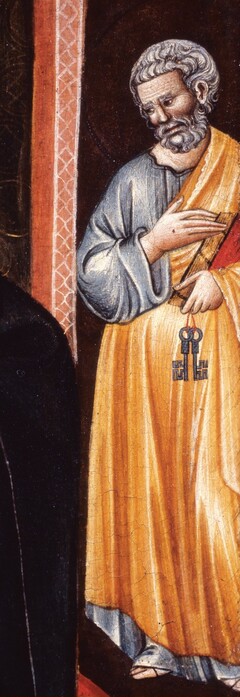 [fig. 3]
 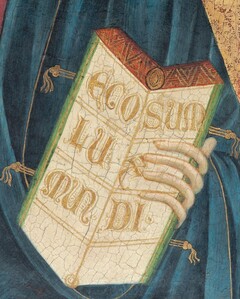 [fig. iv]
Painters of the thirteenth century often represented the blessing Christ with a closed book in his manus. In dissimilarity, examples of Christ holding an open volume reveal the bug involved in foreshortening. Information technology is enough to mention in this regard the already cited altarpiece in the Museo Nazionale in Pisa and the mosaic of Magister Francesco in the apse of Pisa Cathedral. Come across Mariagiulia Burresi and Antonino Caleca, eds., Cimabue a Pisa: La pittura pisana del Duecento da Giunta a Giotto (Pisa, 2005), 202–203; Adriano Peroni, ed., Il Duomo di Pisa, 3 vols. (Modena, 1995), two, pt. 2: pl. 1571. 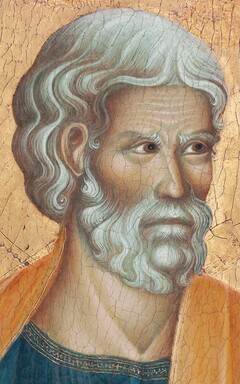 [fig. 5]
Richard Offner, "A Remarkable Exhibition of Italian Paintings," The Arts five (1924): 244.
Fern Rusk Shapley, Catalogue of the Italian Paintings, 2 vols. (Washington, DC, 1979), ane:134.
Miklós Boskovits (1935–2011)
March 21, 2016
Source: https://www.nga.gov/collection/art-object-page.0.html
0 Response to "Online Copy of Nineteenth Century Art a Critical History 3rd Edition"
Post a Comment