Disrupting Thinking: Why How We Read Matters
How to brand reading comprehension instruction engaging with ideas from the volume Disrupting Thinking: Why How We Read Matters by Kylene Beers and Robert Probst
This postal service contains affiliate links.

The Problem With Reading Comprehension Questions
The volume was thick and heavy with a dark blue cover. The print was modest and the pictures were deficient. My 5th-grade-self sighed as I mustered up the motivation to stop one. more. reading. comprehension. question. This was the weekly ritual. Why do I call up how heavy the book was and how slow the job seemed, merely I don't remember whatsoever of the stories?
I don't blame my teacher. I'1000 sure that he was doing the best he could with the materials that he had.
Fast forwards to reading instruction in my ain classroom: My students enjoyed reading new stories together. They loved acting stories out. They lit upwardly when telling me a related story from their lives. But the reading comprehension practice questions…eh, those brought on a lot of heads-propped-upward-on-palms and calling on kids who weren't that excited to participate.
As teachers, we demand kids to understand what they are reading. Unfortunately, traditional comprehension questions listed in basal readers tin can be incredibly dull.

What People Love Virtually Reading
Accept a second to think about times that y'all've really been engrossed in reading. When I read Barbara Kingsolver'due south Animate being, Vegetable, Miracle, it changed the fashion I looked at my food and what it takes to get it from the far reaches of the earth to my tabular array. When I read Scott Westerfield's Uglies with my girl, it changed the style I thought about beauty standards and conformity. When I read a contempo commodity nigh gun violence in America, information technology changed my understanding of motivations behind mass shootings.
In each instance there is a commonality: change. The reading experiences that appoint me the virtually are the ones that change me.
Our students are not as well young to have like experiences when they read. We can transform our reading comprehension practice by showing students how books tin can change them.
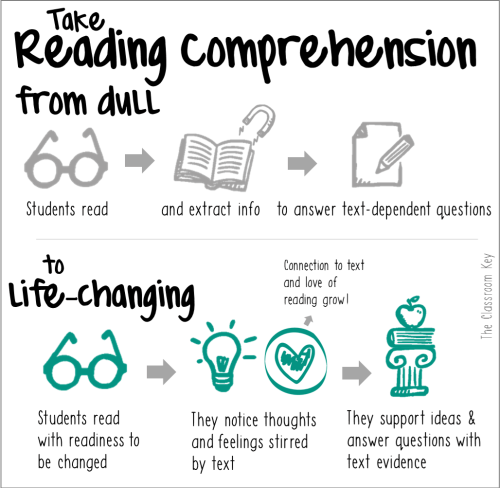
Taking Comprehension Practice from Dull to Meaningful
A hot phrase right now in reading didactics is "text-dependent questions." These are questions that require students to notice evidence in the text in order to answer them. In Disrupting Thinking: Why How We Read Matters, the authors interview several students about their feelings on reading. When one kid asks if he likes to read, he responds, "I did when I was picayune. Now it is virtually 'Do you know your reading level?' and 'Tin you show me the prove?'"
Think about it: nosotros're asking kids over and over to go back and extract information from text. But for what? To write an answer on the page and plow information technology in? But what does it mean to them in their life?
What if we turned reading comprehension on its head and asked kids to connect with text Starting time and then support with text evidence 2d?
A Powerful three-Question Frame Work
Kylene Beers and Robert Probst have suggested a framework of three questions that guide students toward seeing what a text really means to their own lives.
The questions are listed here merely definitely cheque out Disrupting Thinking for a complete understanding:
- What'south in the volume? – Ok, so this is the one nosotros're already proficient at equally teachers. When you lot teach kids to place character traits, use text features, or follow the arc of the plot, y'all're helping them identify what is in the book.
- What is in my caput? – What thoughts are awakened while reading? Students compare the text to what they already know. They may exist surprised or their original thinking may be confirmed. They may develop skepticism for what the author is maxim based on their prior knowledge.
- What is in my middle? – What feelings are awakened while reading? Students examine what the volume helps them larn about themselves or others. Maybe the text changes how the students think nigh the earth. Students consider how their deportment or feelings will change equally a result of reading the text. (There's that word again…change.)


How can this possibly fit in with all the other strategies I'1000 already instruction?
Think of the iii questions above equally umbrellas under which other reading strategies fall.
You teach kids to visualize what they are reading so they tin can understand what is in the book (the first question in the framework). You lot teach them to activate their background cognition and so that compare the text to what they already know (the 2d question). You teach kids to make connections between the text and themselves and the earth (the third questions).
You don't necessarily need to teach more than strategies, just connect the strategies you are instruction to identifying what'south the in the book, what is in their kids' heads, and what is in kids' hearts. If you're like me, you may need to suit so that you're asking "head" and "middle" questions and non just "What'south in the book" questions.

So what about text testify? Students should still be finding text show but not for the sake of extracting information. They should find text evidence to support a connexion they made, something they disagree with, or something that changed their thinking. Beers and Probst describe this as moving from extracting to transacting.
How to Start Implementing Right Abroad
*Emphasize to students that reading is not about calling out words or answering questions on a test. Reading can modify how nosotros understand things and how we act.
*Encourage kids to be responsive to the thoughts and feelings awakened by a text. Make time for these thoughts and feelings to be shared.
*Make sure your comprehension discussions and tasks include practice with all three of the questions above, not just the first one. Instead of asking merely "What does this text say?" also motion to "What does this text say to me? How does information technology change my thinking or agreement?"
*Requite students a chance to talk about text with others. If everyone is making connections between the text and themselves, information technology is enriching to hear the connections and perspectives of others.
*Make sure students know that they don't have to concur with a text. They can question the text.
*Continue in mind that not every text will alter a reader. Sometimes a text confirms what the reader already thinks. At that place is still a thinking and connecting process that goes on to identify that the writer and the reader call back the aforementioned thing.

Hannah Braun is a quondam teacher with 8 years of feel in the classroom and a main's degree in early childhood education. She designs engaging, organized classroom resources for 1st-3rd course teachers.
Source: https://www.theclassroomkey.com/2017/11/reading-comprehension-practice-that-will-have-your-kids-obsessed.html
0 Response to "Disrupting Thinking: Why How We Read Matters"
Post a Comment